Seal Security for banking and financial services

Fix open-source vulnerabilities without touching the platforms that move money

Seal patches the vulnerable code in place, on the version you already run, with no forced upgrade and no regression risk to core banking, payments, or trading systems. Every fix comes with the evidence your auditors and regulators ask for.


Book a remediation review
Protected by Seal
$15T+
in assets under custody, administration and management across our financial-services customers.
Balance sheets
$4T+
in combined total assets, including two global systemically important banks.
Payment volume
$1.7T
in annual payments processed on software Seal keeps patched.
Footprint
60+
markets and 300,000+ employees served by institutions running Seal.
Trusted by leading organizations

How it works

The patch exists upstream. Seal brings it to the version you run.

When a CVE lands, the fix usually ships inside a newer major release. Upgrading means a regression cycle across everything that depends on it. Seal isolates the security fix and backports it onto your exact version, so the finding closes and nothing else changes.

1
Isolate
Take only the added lines from the release that fixes the CVE.
2
Backport
Apply them to the version you actually run, EOL or not.
3
Verify
Build it, run the suite, prove the vulnerability is gone.
4
Deliver
The sealed version lands in Artifactory, Nexus, or CI.
5
Close
Your scanner sees a fixed version and the finding closes.

Built for regulated change control

What banks need that developer-first tools can't provide.

Most remediation tools are built to make engineers faster. Banks need three more things: a patch a change advisory board will actually approve, coverage for systems whose vendors are long gone, and a record an examiner will accept. Seal is built around those three.
Blue rectangular alert box with a black exclamation mark inside a triangle and two green downward arrows on the left.

No forced upgrade

Each patched artifact is a drop-in replacement for the vulnerable one: same major, same API, same behavior. Your change-control board approves a security patch, not a migration.

Blue open-source symbol surrounded by three green shield icons with check marks representing security.

End-of-life coverage

Legacy and acquired systems ship with libraries whose maintainers stopped publishing years ago. Seal backports the fix regardless of upstream support status, so "no patch available" stops being an accepted risk.
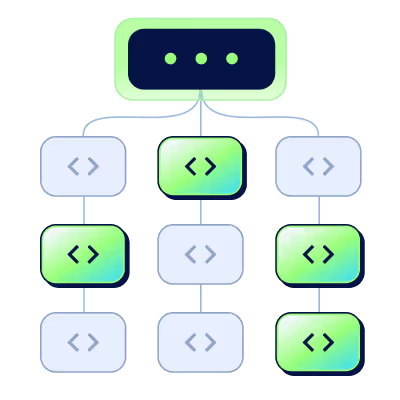
Flowchart diagram with multiple connected nodes, each containing code brackets, showing a branching structure.

Audit evidence

Every fix carries a signed record: CVE, upstream commit, patched version, deployment date, and diff. Exportable for DORA Article 25 testing evidence, PCI DSS 6.3.3 patch logs, and internal audit.
Scanner-only program
Finding logged. Upgrade ticket opened. Blocked pending a regression cycle that never gets scheduled.
vs
Seal
Sealed package pulled from your registry. CVE closed, same version, evidence attached.

Regulatory mapping

Where Seal lands on the frameworks your examiners use

Seal is not a GRC tool. It is the control that makes the remediation line in these frameworks true.

FrameworkRequirementWhat Seal provides
DORAArt. 25, RTS on ICT riskVulnerability assessments, open-source analysis and remediation as part of digital operational resilience testing; oversight of third-party software.Closes findings on third-party code within the entity's own SLA, with per-CVE remediation records suitable for competent-authority review.
PCI DSS 4.0Req. 6.3.1, 6.3.3Identify vulnerabilities in bespoke and third-party software; install critical patches within one month of release.A patch exists on day one, not when the next major version ships. Patch logs map directly to 6.3.3 evidence.
NYDFS Part 500500.7, 500.16Vulnerability management with timely remediation based on risk; documented risk assessment.Predictable, timely remediation on a 72-hour SLA for criticals and highs, so patching becomes a predictable process rather than a constant firefighting exercise.
FFIEC / OCCIT Handbook, Third-Party RiskPatch management for internally developed and vendor-supplied software; evidence for examination.Examination-ready inventory of which CVEs were fixed, how, and when, across in-house and vendor-delivered applications.
SOX ITGCChange managementControlled, documented changes to systems supporting financial reporting.A version-preserving patch is a minimal, reviewable change. Diff and signature are attached to every sealed package.
Impact to date

What Seal has already closed.

Every fix represents a finding closed without an upgrade, a migration, or a regression cycle.

20,000+
Unique CVEs patched
9
Ecosystems covered: Java, Python, JavaScript, Go, Ruby, PHP, .NET, C/C++, Linux packages
25 years
Of release history patched, back to versions whose maintainers stopped publishing
1.2M+
Engineering hours returned to roadmaps instead of forced upgrades
72-hour
SLA for every critical and high, from public disclosure to sealed package
6.5 lines
Average size of a sealed patch. Small enough for change control to actually read
Engineering hours are estimated from CVEs patched multiplied by the average upgrade-and-regression effort avoided per fix.
Next step

Nothing about your environment leaves your building.

We know banks don't share manifests, CVE lists, or architecture without an MNDA. So the first step doesn't ask for any of it. Pick the one that fits your procurement process.

Architecture briefing under your MNDA
We sign your paperwork first. Then a 45-minute walkthrough of how sealed packages flow through Artifactory or Nexus, change control, and audit export, using our environment, not yours.
Coverage check against the public catalog
Tell us only the ecosystems and rough version ranges you care about, for example "Spring 4.x, .NET Framework, RHEL 7", and we return a coverage report from Seal's published patch catalog. No package names required.
Peer reference
A call with a security or platform lead at a financial institution already running Seal, arranged under mutual NDA.
Request a briefing
Choose the path on the call. We'll send our standard MNDA or countersign yours within one business day.

Frequently asked questions

Discover how Seal Security identifies and patches open-source vulnerabilities without breaking changes.

Does a sealed patch need to go through a full change-advisory review?
Can Seal patch libraries our vendor stopped maintaining?
What evidence do we get for examiners and internal audit?
What is the remediation SLA for critical and high CVEs?
Does patching in place satisfy PCI DSS 4.0 requirement 6.3.3?
How does Seal support DORA Article 25 resilience testing?
Do we have to share our dependency manifests or CVE list to start?